We turned down a $180,000 order last month.
A logistics company wanted 80 outdoor payment kiosks for truck stops across the American Southwest. Their RFP specified IP68 protection, 4,500-nit displays, and a budget of $2,200 per unit. Our engineering team ran the numbers: the power draw alone would require electrical infrastructure upgrades at each location costing more than the kiosks themselves.
We told them the math did not work. They found a supplier in Shenzhen who said yes to everything.
That project will fail. Not because we wish it to, but because physics does not negotiate. When it does fail, they will call us. They always do. By then the timeline is wrecked, the budget is blown, and we inherit someone else's mess at premium rates.
This is not an industry overview. If you want to understand what digital kiosk displays are, search elsewhere. This guide is for procurement managers who already know what they need and want to understand which manufacturing decisions will determine whether their deployment runs five years or eighteen months.
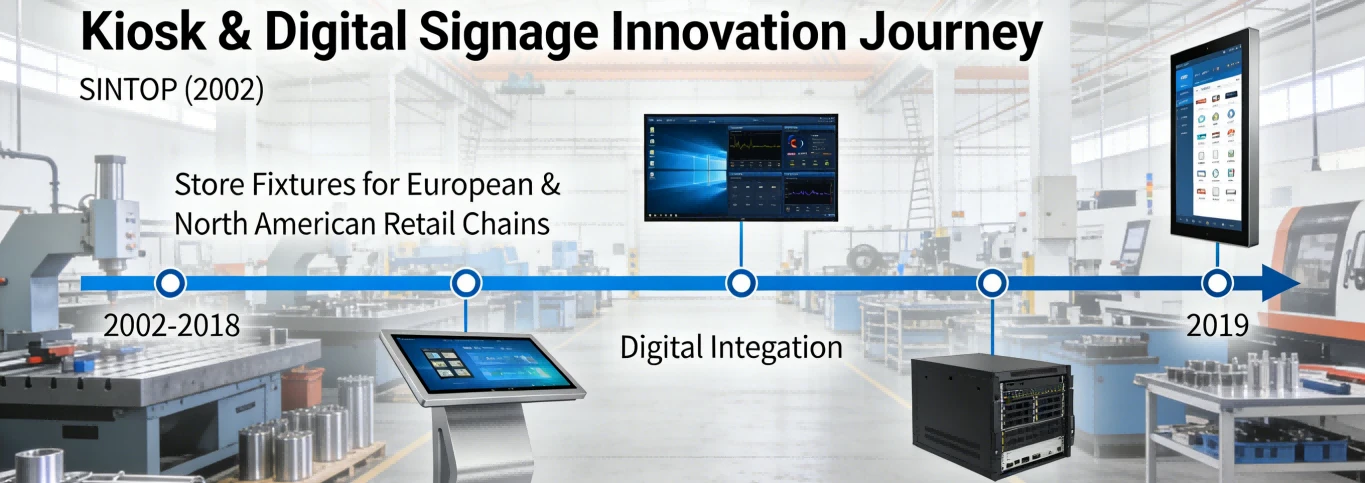
We manufacture kiosk displays and digital signage hardware in Xiamen, China. Our factory started as SINTOP in 2002, building store fixtures for retail chains across Europe and North America. The digital integration came in 2019. That sequence matters: we approach enclosure engineering like metalworkers, not like consumer electronics assemblers who treat the housing as packaging.
Your RFP Probably Has a Contradiction
Most RFPs we receive contain at least one specification conflict that the procurement team has not noticed.
The most common: requesting outdoor deployment with aggressive pricing. Outdoor-rated kiosk displays require high-brightness panels (2,500 nits minimum), active thermal management, optical bonding for sunlight readability, and IP65 or higher enclosures. Each of these adds cost. When an RFP asks for outdoor specs at indoor pricing, one of two things happens: the supplier lies about capabilities, or the supplier declines.
We decline. Then we explain what realistic specifications look like for the actual deployment conditions.
Question we need answered before quoting:
Where exactly will these units be installed? Not "outdoor" or "semi-outdoor." We need: compass orientation of the screen face, hours of direct sun exposure, maximum ambient temperature recorded at that location, and whether permanent shading structures exist.
A west-facing kiosk in Phoenix requires completely different engineering than a north-facing kiosk in Seattle. The first needs 3,500+ nit brightness with active cooling and high-Tni LCD formulations that survive 110°C surface temperatures without blackening. The second works fine with 1,500 nits and passive thermal management.
The price difference between these two configurations is 40-60%. If your RFP does not specify site conditions, you will get either an overpriced quote (supplier assumes worst case) or an underspec'd system (supplier assumes best case and hopes).
Tell us the actual installation environment. We will tell you what configuration survives it.
The Cost Structure We Actually Quote
Hardware represents roughly half your total deployment cost. The other half splits across integration, installation, software licensing, maintenance, spare parts, and energy consumption over the equipment lifecycle.
Procurement teams focus on unit price. Finance teams should focus on five-year total cost. Here is how the math typically breaks down for a 50-unit retail kiosk deployment:
| Cost Category | Year 1 | Years 2-5 | Five-Year Total |
|---|---|---|---|
| Hardware (our scope) | $185,000 | - | $185,000 |
| Software/CMS licensing | $12,500 | $50,000 | $62,500 |
| Installation & integration | $35,000 | - | $35,000 |
| Maintenance & field service | $8,000 | $32,000 | $40,000 |
| Spare parts consumption | $2,000 | $15,000 | $17,000 |
| Energy (avg 180W × 16hr/day) | $7,800 | $31,200 | $39,000 |
| Total | $250,300 | $128,200 | $378,500 |
The hardware line is what we control. The others depend on your integration partner, your CMS vendor, your electricity rates, and your maintenance strategy.
What we guarantee: spare parts availability for five years from shipment date. Boards, panels, power supplies, touch controllers. If a component fails in year four, you can order a replacement from us. We stock standard configurations. Custom specs may require minimum order quantities for replacement inventory, which we discuss during quotation.
What we do not provide: POS integration, payment processing certification, or field service dispatch. If your deployment requires PCI-DSS compliance or direct integration with proprietary point-of-sale systems, you need a systems integrator. We supply hardware to their specifications.
Why Panel Brand Arguments Miss the Point
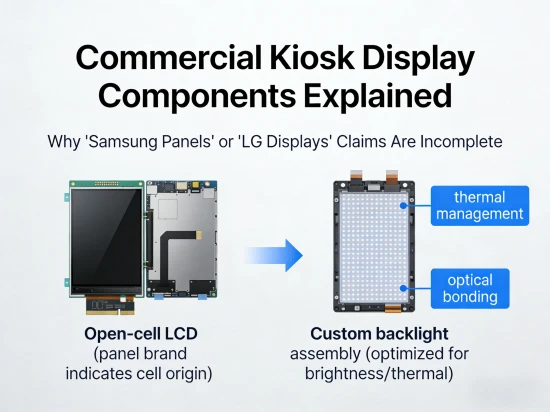
Your competitor's sales rep probably told you their kiosks use "Samsung panels" or "LG displays." That statement is almost certainly incomplete.
Commercial kiosk manufacturers rarely buy finished display modules from tier-one suppliers. The standard practice is purchasing open-cell LCD components and integrating custom backlight assemblies optimized for specific brightness and thermal requirements. The panel brand indicates the LCD cell origin. It says nothing about backlight quality, thermal management, or optical bonding implementation.
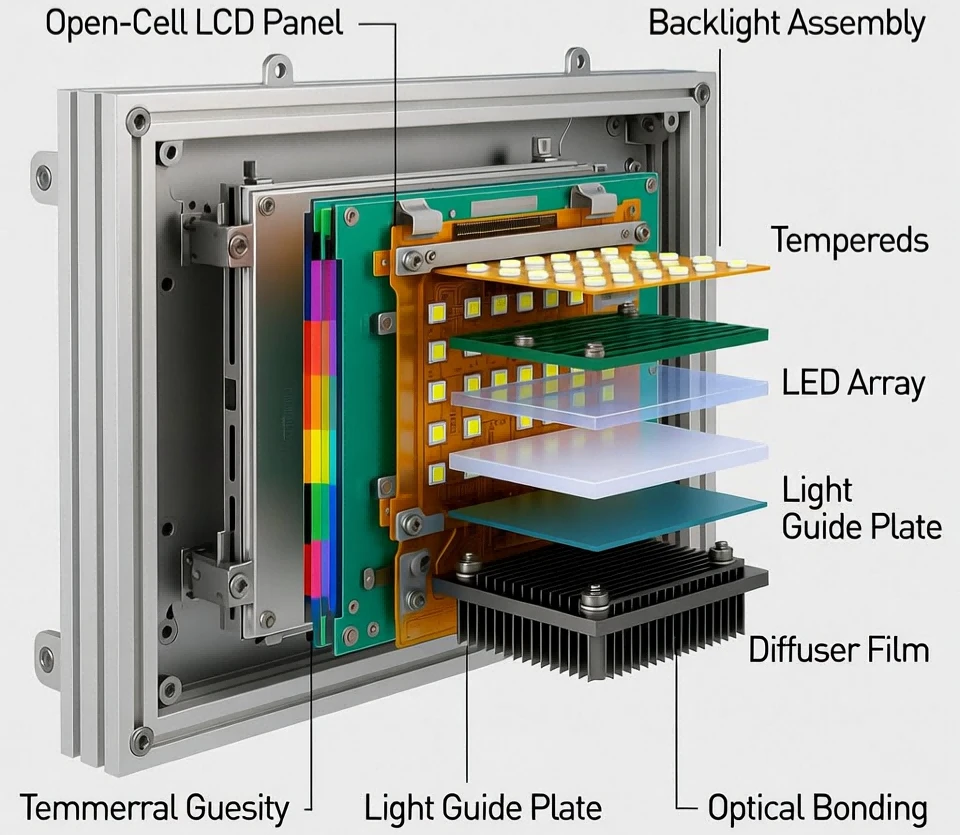
We source cells from BOE and AUO for standard configurations. Both deliver equivalent MTBF performance in the 1,500-2,500 nit range. The supply chain advantage: both manufacturers operate in mainland China, so component replacement reaches our factory in 48-72 hours rather than the 5-7 days required for Korean-sourced alternatives.
If your corporate procurement policy mandates specific panel brands, we can accommodate that with adjusted pricing and lead times. But understand what you are actually specifying. A BOE cell with properly engineered thermal management and optical bonding will outperform an LG cell in a poorly designed enclosure. Panel brand is one variable. System integration is what determines field reliability.
Burn-In Testing That You Can Verify
Every unit we ship runs 72 hours under load before packing. This catches weak capacitors, marginal solder joints, and thermal management failures that would otherwise appear within the first 90 days of deployment.
The claim is meaningless without verification. Suppliers who run 8-hour "burn-in" tests call them burn-in tests too.
How you can verify our process:
For orders exceeding 20 units, we offer production observation. Your technical representative joins a video call during the test cycle and receives access to real-time monitoring dashboards showing temperature curves, power consumption, and fault detection logs. The complete test report ships with your units, including timestamped sensor data.
For smaller orders, we provide batch-level test summaries with unit serial numbers correlated to test timestamps. If a unit fails within 12 months, we cross-reference against the original test data to identify whether the failure mode was detectable during manufacturing quality control.
Our published first-year field failure rate is under 2%. We back this with a warranty commitment: if your deployment experiences failure rates exceeding 4% in year one, we credit 15% of the affected units' purchase price against future orders.
That is not marketing language. It is a contractual term we include in purchase agreements for qualified projects.
When Optical Bonding Is Worth 28% More
Optical bonding eliminates the air gap between LCD panel and cover glass, reducing internal reflections and improving sunlight readability. The process increases contrast ratio by 4-10× in high-ambient-light conditions (source: e3displays.com technical documentation).
We charge 28% additional for optical bonding through our 3M partnership. That premium is justified in specific conditions and wasteful in others.
Situations where bonding pays back:
Screen faces west or south with afternoon sun exposure during peak usage hours. Glass curtain wall locations where reflected sunlight creates glare. Outdoor installations without permanent shade structures. Environments where the kiosk surface reaches temperatures above 50°C and condensation would form in an air-gapped assembly.
Situations where standard assembly is sufficient:
Indoor retail with controlled lighting. North-facing outdoor installations in temperate climates. Locations with architectural shading that blocks direct sun during operating hours.
We do not upsell bonding to clients who do not need it. The conversation we want to have: send us site photos with compass orientation, and we will tell you whether the premium is justified for your specific deployment.
Projects we turn down:
- Payment kiosks requiring integrated HSM modules for PCI-DSS compliance. We manufacture enclosures and display systems. Hardware security module integration belongs with certified payment specialists.
- Outdoor installations in ambient temperatures exceeding 55°C without client commitment to active air conditioning infrastructure. The physics of LCD thermal management has limits. Promising otherwise guarantees field failures.
- Rush custom enclosures with lead times under three weeks. Our CNC and powder coating lines have minimum cycle times. Standard configurations can ship faster. Custom metalwork cannot.
- Single-unit orders outside of sample evaluation programs. Our minimum practical quantity for custom work is 5 units. Individual units are available as evaluation samples at higher per-unit pricing, credited against production orders if you proceed.
Projects we handle well:
- Retail chain deployments of 20-500 units with standard configuration options. Custom enclosure designs with 30-40 day lead time allowance. Outdoor installations in climates where our IP65/IP67 thermal management systems operate within rated parameters. Clients who have completed site surveys and know their actual installation conditions.
A Project That Almost Failed (And Why It Did Not)
Last year a European grocery chain contacted us after their original supplier delivered 35 self-checkout kiosks that began failing within four months. Touch screens became unresponsive. Several units showed display artifacts. The enclosures developed visible corrosion around ventilation ports.
The failure mode analysis was straightforward: the original supplier used consumer-grade components in a commercial application. The touch controllers were rated for 10-hour daily operation, not the 16-hour shifts the stores actually ran. The powder coating was cosmetic grade, not the industrial formulation required for environments with cleaning chemicals.
We replaced the internal electronics and recoated the enclosures. The project cost the grocery chain approximately €45,000 beyond what proper specification would have required initially. Their procurement team now sends us RFPs before issuing tenders, specifically to validate that specifications are realistic before the bidding process starts.
That consulting relationship did not generate direct revenue. It generated three subsequent hardware orders totaling 280 units across the chain's expansion markets.
The point is not that competitors fail. The point is that specification accuracy at the procurement stage prevents expensive corrections later. We would rather lose a deal by telling a client their budget is unrealistic than win a deal that becomes a warranty liability.
Current Lead Times and Capacity
Standard indoor kiosk configurations ship in 15-20 business days from order confirmation. Custom enclosure projects require 30-40 days.
Our Q2 production schedule is currently 65% committed. Large orders placed before end of March can slot into remaining Q2 capacity.
Orders confirmed after that date will schedule into Q3 with delivery windows starting late June.
If your project timeline requires Q2 delivery and you have not yet finalized technical specifications, the window for completing engineering review and placing orders is narrowing. We prioritize specification finalization calls for projects with confirmed deployment dates.
Starting the Conversation
If you are evaluating custom kiosk display manufacturing for retail deployment, the information we need to provide a meaningful quote:
Deployment quantity and rollout timeline. Installation environment details including location type, sun exposure, and temperature range.
Integration requirements with existing systems. Budget parameters including whether you have allocated for five-year total cost or hardware-only.
Send project details to grace@legoyodigitaldisplay.com.
Include "Kiosk RFP" in the subject line with your company name. We respond to complete inquiries within one business day. Incomplete specifications receive a clarification request rather than a generic quote.
For projects exceeding 50 units, we schedule a technical review call before quoting. Thirty minutes with your procurement and technical teams prevents weeks of revision cycles later.
We do not quote against vague RFPs. We do not match prices from suppliers who promise specifications they cannot deliver. We build hardware that works for five years in the conditions you actually deploy it.
If that approach fits how you evaluate suppliers, we should talk.